potret mimpi..

potret mimpi..
travelling is a must

Saturday, October 6, 2012

#ibuzzkorea# Korean Music Folk


Korea's folk music tradition, with its generous use of bright rhythms and melodies, offers a more energetic and capricious contrast to the nation's collection of classical music works. Folk music represents the soul and sound of traditional Korean villages with an eclectic array of music forms including numerous folk songs, various forms of instrumental pieces, pansori, and shaman ritual music. Some of the most prominent pieces and folk music forms are as follows:
Folk Music Pieces

1.    Sanjo

The word sanjo literally means scattered modes and refers to the fact that these pieces employ a variety of rhythmic and tonal modes. When court musicians first heard these sanjo pieces, they didn't think of it as music but rather a disorganised collection of scattered modes.
Kayagum master Kim Chang-Jo is credited with creating the very first sanjo piece around 1890 and since then this solo instrumental form has been adapted for most other traditional instruments. The music relies heavily on improvisation and the most prominent musical characteristic is that the piece increases in tempo as it progresses through the various rhythmic modes.
The accompaniment of the janggu is also important in establishing the rhythmic foundation for the instrumentalist. A sanjo is technically quite brilliant, particularly in the strident rhythms found in the final sections of the piece.

2.    Sinawi

Sinawi is an instrumental music form used in shaman ceremonies to accompany dancing and to help bring the shaman to a higher state of consciousness. The music is highly improvisational and the instruments weave together a thick layer of melodies played over the rhythms of a janggu. Sinawi also influenced the development of both pansori and sanjo music forms.

3.    Pansori

Pansori is an epic narrative song form unique to Korean music culture. Musicologists do not necessarily agree on the origin of the music form but one recent theory suggests that it developed out of Korea's story-telling tradition, that story-tellers gradually began to include musical elements to make their performances more captivating for the audience.
The development of pansori was strongly influenced by shaman rituals as illustrated by common elements which exist in both music forms. The vocalist alternates between speaking and singing as the story progresses and uses a fan and a handkerchief to help illustrate the various scenes of the story. The speaking sections are referred to as aniri, the singing as sori, and the actions as ballim. The barrel drum player or members of the audience can call out words of agreement or encouragement throughout the performance and these vocal exhortations are called chuimsae.

Pansori was popular in the 18th and 19th centuries and documents show us that there were originally 12 works but today only 5 works remain in performance practice. These works are performed entirely by a single vocalist accompanied by a barrel drum which is rather challenging as full performances can last up to 8 hours in some cases. The text of four of the remaining works are traditional Korean stories while the fith work is based on a traditional Chinese story. The 5 remaining works of pansori are: Song of Chunhyang, Song of Shimchong, Song of Heungbo, The Underwater Kingdom, and Song at Red Cliff.

Song of Chunhyang:This is the most popular of the five remaining works of pansori, Korea's unique epic narrative vocal form. There is an ancient legend associated with this pansori work which tells of a small southern village called Namwon and a village girl called Chunhyang. Apparently Chunhyang was quite ugly and unpopular, often finding herself the object of scorn and menace. She is eventually imprisoned and then executed under false charges. Soon after, the village of Namwon falls into disarray. A number of magistrates die under mysterious circumstances and the village suffers several years of poor harvests. One village magistrate suspects that a curse has been placed on the village by Chunhyang's angry spirit. To appease her, the magistrate writes a tale of deceit and treachery, but also of love. Chunhyang is described in beautiful terms and in the end marries the most handsome lad of the village. This seemed to satisfy Chunhyang's angry soul as Namwon then enjoyed great prosperity. The text used in this pansori work "Song of Chunhyang" is this very text penned by the village magistrate centuries ago. That's what the legend tells us.

Song of Shimchong:This epic tells the ultimate story of faithful servitude and sacrifice. Shimchong is the only daughter of a blind man. Together they live in poverty and Shimchong must venture out daily to beg for meager scraps of food to support themselves. Finally, Shimchong sells herself as a sacrifice in exchange for 300 bushels of rice. Shimchong is thrown off a high cliff into the sea but this is where the story takes a curious twist. The ever-powerful Jade King saves Shimchong as she wakes up inside a lotus leaf. The two are married. Later Shimchong is reunited with her father and his sight is restored.

Song of Heungbo: This pansori piece is also a highly popular piece and a famous traditional folktale in Korea. It tells the story of two brothers, Heungbo and Nolbo, who wander through life with different minds. Heungbo is the kind guy while Nolbo is quite selfish and nasty. One day, Heungbo finds in his garden a baby swallow with a broken leg. Heungbo bandages the leg and nurses the little swallow back to health. A year later, the swallow returns with a gourd seed for Heungbo. After Heungbo plants the seed, the gourd grows quickly and what should he find inside the gourd but great treasures and riches. Upon hearing this news, Nolbo finds a swallow for himself, breaks the swallow's leg, and then bandages it up again. Sure enough, the swallow returns with a gourd seed for Nolbo. However, Nolbo opens the gourd revealing devilish things which bring misery and hardship to his life. In the end though, Heungbo invites Nolbo into his house and they live a merry life together with Heungbo's family. Moral of the story: Be nice to swallows because if they don't like you, you've got problems.

The Underwater Kingdom: The Underwater Kingdom tells the story of a dragon king who rules the underwater kingdom. The king is sick and has been told that he needs a rabbit's liver in order to cure his sickness. He sends a terrapin up to the land entrusted with the task of bringing him back a rabbit. Problems arise when the terrapin arrives on land only to realise that he doesn't actually know what a rabbit is. After a few encounters with other animals the terrapin finally does manage to find a rabbit and bring it back to the dragon king. But in a delightful twist the rabbit outwits the king and succeeds in escaping from his dragonic clutches. Song at Red Cliff

4.    Chapga

This is a song form which was in vogue around the beginning of the 20th century. It shows influences from panosir and folk songs, has various structural forms, and uses texts from numerous different sources. The chapga form includes ipchang (standing songs) and chwachang (seated songs). The specific characteristics of chapga songs differ according to region.

5.    Folk Songs

As Koreans are known for their natural singing ability it should be no surprise that the nation has cultivated a large collection of folk songs. These songs are normally classified according to five regions of the nation: northwestern region • Seoul & Kyonggi Province • eastern region • southern region • Cheju Island. Each region has its own collection of songs and vocal styles which are quite distinctive. Also, each region bases its songs on a slightly different melodic scale. There are a number of folk songs common to all regions of Korea although they might exist in slightly different variations. Some of these common folk songs are: Arirang, Miryang Arirang, Doraji-Taryong, Banga-Taryong, Kangwondo-Arirang, Nongbuga, Yukjabaegi, Susimga, and Cheonan-Samgeori.There are also collections of folk songs associated with various activities, such as:
farm songs, fishing songs, work songs, ceremonial songs, marriage songs, and children's songs.

6.    Pungmullori & Samullori

Pungmullori is a form of farmer's music which uses lively percussion and the melodic wanderings of the taepyongso. This music was performed in villages at various farm festivals, occasions ,and celebrations, also included dances and games. Samullori, which literally means "four-piece-play", is a modern percussion form created in 1978 by Kim Duk Soo and three of his associates. This music is based on the traditional farm music pungmullori and employs ggwaengari, jing, janggu, and buk. This music is rightfully brilliant and energetic, popular both in Korea and internationally. Kim Duk Soo has combined this samullori music with other Korean and Western instruments to create music with both Korean tradition and Western jazz elements.

7.    Shaman Ritual Music

For centuries Korean people have cultivated shamanism, developing a large collection of lively mystical performance rituals. The musical elements include vocal songs, instrumental accompaniment, and purely instrumental pieces, such as sinawi. The rituals are normally led by a single shaman accompanied by a small energetic instrumental troupe. Rituals are performed for several purposes, such as sending wishes or appeals to the gods, to contact the souls of ancient people, or simply to entertain and appease the gods. The musical characteristics of these shaman rituals differ somewhat according to region much like the various folk song styles. A number of shaman songs have become quite popular and have essentially been assimilated into the general folk music tradition.

#ibuzzkorea# you must be hungry then...


Korean Cuisine

Korean food is mostly nutritious and fermented. Consequently, it is considered healthy and a good defense against cancer. It is the list of The Top 10 Korean foods that you have to try:

Kimchi

 Kimchi is the most famous Korean food. It is salted and fermented Korean cabbage, presented as a side dish in any meal. It is rich in vitamins and minerals. Kimchi is the national dish of Korea. As we know as an Indonesian we also know and eat several fermented food such as tempe, tahu, oncom, yoghurt, bread, etc. In the case of kimchi the cabbage is coated leaf by leaf in a delicious spicy mix of hot pepper flakes, garlic, chives, onion, pear juice, and more. It is then able to be eaten right away or you can leave it out of the refrigerator for two or three days to start the fermentation process. As it ferments it develops a rich and slightly sour flavor. It lasts for months and is also used as the base for many other dishes such as kimchi stew and even as a filling for kimbap (Korean sushi). Kimchi is such an important dish in Korea that it is eaten with breakfast, lunch, and dinner.
Bibimbap

Bibimbap. In Korean, “bibim” means “mixed” and “bap” means rice. All of the ingredients except the meat (which is optional) are prepared in advance so you can add them at room temperature to the top of hot steamed rice. You then quickly fry and add the meat and a sunny-side up egg to the top. Bibimbap is usually served with a spicy sauce made from gochujang (Korean hot pepper paste) which you can add to your liking – allowing you to control how hot it is. You then use your spoon (Korean food is always served with metal chopsticks and a spoon) to “bibim” it all until it is completely mixed together. This really is a taste sensation and it really is impossible not to fall in love at first bite. I have try it several times, but in Indonesia off course. If we compare with our food, it will be nasi rames i guest..hahahah
Bulgogi


 Bulgogi, Korean barbeque, is thinly sliced sirloin marinated in soy sauce with sasame oil and garlic, among other condiments. Typically in the west we eat bulgogi on a korean barbecue – a hot plate in the middle of the table. But in Korea this is just one of many ways. It can be made into a stew or as the basis for other dishes. There are as many recipes as their are uses. The end result is a delicious sweet, savory, and soft slice of meat. As for me I prefer to eat it with small amount of rice and dipping sauce in a lettuce leaf, just like Samgyupsal. It is also incredibly low fat and very healthy.
Japchae

 Japchae is one of the most popular Korean dishes both inside and outside of Korea and when you taste it you will understand why. Originally japchae was made without noodles – it was invented for the King by one of his chefs and he loved it so much that it became famous across Korea. In more recent times the noodles were added and now they are an essential element to the dish. The noodles used are sweet potato starch noodles which give japchae its very distinct chewy texture. The vegetables are all lightly cooked so they retain all their flavor. This is definitely a great alternative to the typical (and often bland) stir fry we all cook at home when we want “Chinesen”. That will be very similar with the capcay we often eat in Indonesia.
Yangnyeom Tongdak

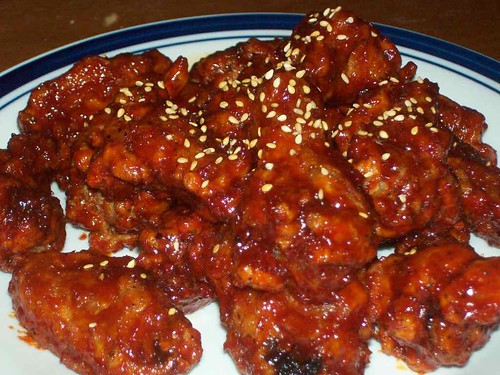
Yangnyeom Tongdak (seasoned fried chicken). This fried chicken has to be tasted to be believed. When you bite into a piece of this chicken you are initially met with a sticky, sweet, spicy red sauce. Maybe like ayam balado for us Indonesian. This really is one of the most delicious Korean foods ever invented. In Korea there are many shops selling their own special version of yangnyeom tongdak and they deliver until the late house of the night. But home made is always better. This recipe is particularly good as it shows (because of the addition of ketchup) how Koreans are willing to adopt foreign flavors and use them to their advantage. You need to try this as soon as possible.
Hoeddeok

Hoeddeok, is sweet syrupy Korean Pancake. If you have a sweet tooth you are guaranteed satisfaction with this amazing pancake sold by street vendors. It is a little more complex than a western style pancake because it is made with a yeast dough but the effort is well worth it. The dough (virtually identical to a western bread dough) is filled with a mixture of cinnamon, brown sugar, and chopped walnuts and fried in a lightly oiled pan until the filling has melted into a syrup. This really is the queen of pancakes and it is incredibly popular with children. Try this out next time the kids want pancakes for breakfast – they will love you for it. And if you don’t like the sound of the filling or don’t have a sweet tooth, just fill it with mozzarella cheese instead.
Dakjuk

Dakjuk (chicken porridge) or bubur ayam in Indonesia..hahah.. Essentially you boil a chicken in a huge pot of water with onions and a lot of garlic – then you add sushi rice and cook it until the chicken is done. The end result is a thick stew (which Koreans refer to as a porridge even though it has no oats) caused by the rice breaking down bursting with rich chicken and garlic flavor. You tear the chicken up and eat it with the porridge. This is a meal you will make again and again because it really is super easy.
Ttokbokki

Ddukbokkie is the delicious smell of Korean cities at night. In large Korean cities like Seoul, the streets are filled with vendors selling their own special recipe versions of the most popular street food. Ddukbokkie (it is pronounced roughly like “dok-bok-ee”) is one of the most popular and it comes in various styles. The sauce is spicy but it is also very sweet and packed with an immense amount of flavor. The spiciness is cut by the long cylindrical rice cakes which, when cooked, become chewy and soft. I think it’s fine if we want to try the original one even I already tested it in several Korean restaurant in Indonesia.
Seolleongtang

Seolleongtang is an incredibly popular soup in Korea – there are even restaurants who specialize in making just it. Of all the items on this list, seolleongtang is the most time consuming as you must boil the beef bones (typically ox leg bones but you can make do with ox tail) for hours and hours to release all of the calcium which gives it the very distinctive white look. But don’t be fooled by the color – this is the beefiest tasting soup you can imagine! When you boil the bones you can also add a large piece of beef and radish which you slice and add to the soup at the last minute. While this is a great winter soup it is also delicious in summer. It also makes a huge quantity so you can make it on the weekend and consume it during the week. In Korea this might be eaten for breakfast – not just dinner – as Korean’s typically have soup, rice, and side dishes for breakfast.
Soondubu Jiggae

Soondubu jiggae is a Korean stew (jiggae) – thicker than a soup but thinner than a porridge. When cooked in the traditional way all of the cooking is done in just the one dish. This makes it very easy to clean up afterwards – a job we all hate. It starts with a delicious fish stock and a little beef to deepen the flavor then finished off with fresh shell fish, hot pepper flakes, silken tofu, and eggs which are optional. The small amount of beef is typical of Korean food and illustrates how healthy it is – the meat is used for flavor rather than stomach filling. This is a dish everyone should try – it is really one of the nicest ways to introduce someone to tofu which picks up all of the flavors of the stew while adding a soft comforting texture. Eat it with rice and side dishes for a complete meal.

Friday, October 5, 2012

#ibuzzkorea# Korea’s World Heritage


UNESCO has so far named seven Korean sites to the World Heritage list :
Bulguksa Temple

Bulguksa in Gyeongju was built in 774 during the Silla periode. Its architectural design has become the standard for temple construction.
Seokguram

Seokguram is a man made vave carved from white granite featuring a seated  Buddha and 38 other Bodhisattvas on the walls. Seokguram exquisitely combines Silla’s knowledge of architecture, math, geometry, physics, religion, and art into an organic whole.

Jongmyo is the royal ancestral shrine where the spirit tablets of Joseon kings and queen-consorts are enshrined and rituals performed. A ceremony is held on every first Sunday on May. The ritual and music used for the ceremony have been designated as Intangible Cultural Properties No. 56 and No. 1, respectively.
Tripitaka Koreana

Tripitaka Koreana is the oldest and most comprehensive compilation of Buddhist scriptures in existence today. It was carved on 81,340 woodblocks during the Goryeo Dynasty (918-1392).
Haeinsa Temple

The Janggyeongpanjeon at Haeinsa Temple is their repositories which has never been demaged by fire on war since  its first construction in 1488.
Changdeokgung

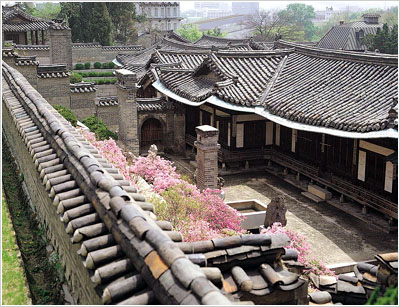
One of the five palaces in Seoul, Changdeokgung is free from the traditional symetrical or lineal arrangement of structures and was designed instead in accordance with the surrounding topography. It is a fine example of ancient Korean landscaping with a lotus pond , some 300-year-old trees, and a pavilion all arranged in harmony with their surrounding.
Hwaseong Fortrees

Hwaseong Fortress in Suwon was built by King Jeongjo (r. 1776-1800) as an act of filial piety to restore the honor of his father who was murdered as a result of palace intrigue. The Fortrees was design by Jeong Yak-Yong knows as Dasan, one of the greatest Confucian Silhak (Schoolar of Practical Learning) schoolars.
Dolmen Site

Gyeongju Historic Area and Dolmen sites in the counties of Gochang, Hwasun, and Ganghwa were also added to the list in 2000. Gyeongju was the capital of the Silla Kingdom for a thousand years and the area is called a “Museum Without Walls” because of the remains.

In addition, UNESCO placed the Royal Ancestral Rite and Ritual Music of Jongmyo Shrine, Pansori Epic Chant, and Gangneung Danoje Festival among the masterpieces of the Oral and Intangible Heritage of Humanity. Also, the World Textual Heritage contains the Hunminjeongeum (correct sound to instruct the people, a primer for teaching Hangeul, the Korean alphabet) and Joseonwangjosillok (the court journals of the Joseon Dynasty); Seung jeongwonilgi, a daily account of Joseon court events ; and Jikjisimcheyojeol, the oldest book printed with metal type, dating back to 1377.

www.korea.net

Thursday, October 4, 2012

#ibuzzkorea# Seoul thai is soul ..


Gyeongbokgung


Seoul, the capital of Korea, is a teeming metropolis with the population of over 10 million. It is a fascinating city where the past and the present coexsist. Centuries-old palaces, gates, royal tombs, and shrines are juxtaposed with soaring skyscrapers, in high-tech infrastructure and bustling businesses. Within a 10 minute walk from City Hall are palaces of the last dynasty like Gyeongbokgung, Deoksugung, changdeokgung, Changgyeonggung, and Gyeonghuigung. 
Namsan Tower

Seoul Tower on top of Namsan is one of the major landmarks of the city. The stream Cheonggyecheon was restored in 2005 and now flows through the heart of Seoul. Insa-dong street shocases art galleries and traditional craft shops. Mountaints are all arround the city, providing the people with beautiful sights and natural comfort.

#ibuzzkorea# Korean Constitution and Goverment


The Constitution of the Republic of Korea was first formulgated on July 17, 1948. The Constitution guarantiees the basic rights and freedoms of the people including  equality before the law, freedom from arbitrary arrest, freedom of residence, the right to vote and hold public office, the right to privacy, freedom of religion, speech, the press and assembly, as well as the right to a clean environment and pursuit of happines.

Under the presidential system, the goverment consist of three branches : the legislature, in the form of a unicameral National Assembly; the judiciary, consisting of district and apellate or high courts and the supreme court; and the executive headed by the president who is the head of state and commander-in-chief of the Armed Forces. The President is assisted by the Prime Minister and the State Council, including the Cabinet.

Suffrage : All citizens age 19 or older are eligible to vote
Elections : 
presidential : every five years, 
National Assembly : every four years, 
Local Councils : every four year.

Wednesday, October 3, 2012

#ibuzzkorea# Korean People and Language

Korean people and Language

Korean’s are primarily speaking one language. They are believed to be the descendants of mongol tribes who migrated to Peninsula during the Neolithic through Bronze ages.
Korean People and Language

The Korean language, like Hungarian, Turkish, Mongolian, and Finnish, belongs to the Ural-Altaic language group. Hangeul, the Korean alphabet, is composed of 10 vowels and 14 consonants. King Sejong the great and his scholars created this writing system in 1443 because, while they spoke a different language from chinese or Japanese, Koreans were relying on chinese characters to study, teach, and communicate. Today the Hangeul writing systems is used by 70 million South and North Koreans, as well as five million overseas Koreans. This information follows the goverment’s revised Romanization System for Hangeul which was adopted in July 2000.


www.Korea.net

Tuesday, October 2, 2012

#ibuzzkorea# Korean Land and Climate


The Korean Peninsula is situated continent extending about 1,1000 km long. China lies across the Yellow Sea to the west, while Japan is across the East Sea to the east. Mountaints cover 70% of the land area and over 3000 island are scattered along the coasts. The Peninsula is currently divided into  the Republic of Korea (ROK) in the south and the Democratic People’s Republic of Korea (DPRK) in the north, separated by the demiliterized zone (DMZ).
Spring

Summer

Korea belongs to the temperate zone with four distinct seasons. Springs is rather short but very pleasant and sunny. Summer is hot and humid with monsoon rainfalls in July. Autumn is especially beautiful as vivid as golds and vibrant reds create a colorful panorama. Winter is cold and dry with occasional snow. Jeju-do (island) in the southwest of the Peninsula has a mild subtropical climate.
Fall
Winter