
UNESCO
has so far named seven Korean sites to the World Heritage list :
 |
| Bulguksa Temple |
Bulguksa
in Gyeongju was built in 774 during the Silla periode. Its architectural design
has become the standard for temple construction.
 |
| Seokguram |
Seokguram
is a man made vave carved from white granite featuring a seated Buddha and 38 other Bodhisattvas on the
walls. Seokguram exquisitely combines Silla’s knowledge of architecture, math,
geometry, physics, religion, and art into an organic whole.

Jongmyo
is the royal ancestral shrine where the spirit tablets of Joseon kings and
queen-consorts are enshrined and rituals performed. A ceremony is held on every
first Sunday on May. The ritual and music used for the ceremony have been
designated as Intangible Cultural Properties No. 56 and No. 1, respectively.
 |
| Tripitaka Koreana |
Tripitaka
Koreana is the oldest and most comprehensive compilation of Buddhist scriptures
in existence today. It was carved on 81,340 woodblocks during the Goryeo
Dynasty (918-1392).
 |
| Haeinsa Temple |
The
Janggyeongpanjeon at Haeinsa Temple is their repositories which has never been
demaged by fire on war since its first
construction in 1488.
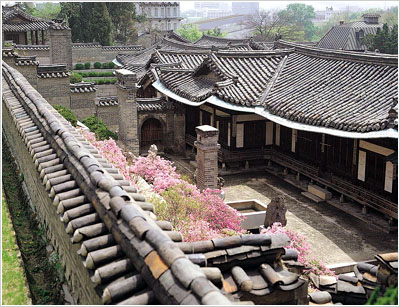 |
| Changdeokgung |
One
of the five palaces in Seoul, Changdeokgung is free from the traditional
symetrical or lineal arrangement of structures and was designed instead in
accordance with the surrounding topography. It is a fine example of ancient
Korean landscaping with a lotus pond , some 300-year-old trees, and a pavilion
all arranged in harmony with their surrounding.
 |
| Hwaseong Fortrees |
Hwaseong
Fortress in Suwon was built by King Jeongjo (r. 1776-1800) as an act of filial
piety to restore the honor of his father who was murdered as a result of palace
intrigue. The Fortrees was design by Jeong Yak-Yong knows as Dasan, one of the
greatest Confucian Silhak (Schoolar of Practical Learning) schoolars.
 |
| Dolmen Site |
Gyeongju
Historic Area and Dolmen sites in the counties of Gochang, Hwasun, and Ganghwa
were also added to the list in 2000. Gyeongju was the capital of the Silla
Kingdom for a thousand years and the area is called a “Museum Without Walls”
because of the remains.
In
addition, UNESCO placed the Royal Ancestral Rite and Ritual Music of Jongmyo
Shrine, Pansori Epic Chant, and Gangneung Danoje Festival among the
masterpieces of the Oral and Intangible Heritage of Humanity. Also, the World
Textual Heritage contains the Hunminjeongeum (correct sound to instruct the
people, a primer for teaching Hangeul, the Korean alphabet) and
Joseonwangjosillok (the court journals of the Joseon Dynasty); Seung
jeongwonilgi, a daily account of Joseon court events ; and Jikjisimcheyojeol,
the oldest book printed with metal type, dating back to 1377.
www.korea.net


No comments:
Post a Comment
komentar ga bayar kok..hohoho